


Our Experience with Eccrine Carcinoma – Rare and Aggressive Cancer
Shocking News
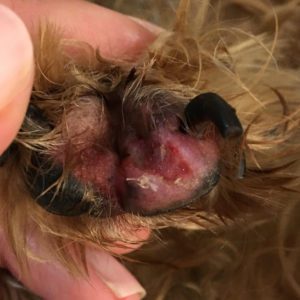
In March 2016, McCarthy, my beloved little 11-year- and 9-month old Yorkie, developed a mysterious cut on the third toe of his right foot. He was stitched up and treated with antibiotics, but it wasn’t healing, was very swollen, and in no time the swelling started spreading to the second toe and underneath the pads too.
A further dose of antibiotics was given, but still little healing. A biopsy was taken on 29 April 2016, and on 11 May 2016, I received the shocking news: Eccrine carcinoma – which is an extremely rare and aggressive cancer of the sweat glands. The prognosis on the pathology report said: “Cautious, further complications as regards local infiltrative growth and distant metastatic spread could be expected.” Apparently, an important differential in these cases is metastatic carcinoma from the lung.
Little McCarthy was the sweetest, most loving, and joyful being I had ever met. He loved life and had no idea how small he was in size. He used to run 10 km races with me, and we regularly ran 6 – 8 kilometres on the road or in the mountain until he was about nine years old. As he aged we walked more, which his Yorkie brother, Higgins preferred. I couldn’t believe this devastating news, as he was still as sprightly as ever, despite having an aggressive form of cancer eating its way through his toes.
Unwanted and Unfamiliar Territory
The week after the diagnosis he had to go for a CT scan to determine whether the cancer had spread. If not, surgery or amputation was indicated.
I dropped him off at the animal hospital on 18 May 2016 for the CT scan. The specialist advised me that he would be on a drip before, during, and after the procedure as some dogs had a bad reaction to the iodine dye they were injected with, which was a necessary procedure for a contrasted CT scan. I was also informed that the specialist stops the dog breathing for 30 to 45 seconds when scanning the lungs, as one cannot tell a dog to hold its breath. It is an incredibly stressful ordeal to have to go through, especially the day-long waiting period to find out whether the cancer had spread to his lungs.
Later that afternoon, I was relieved to hear that it had not spread to his organs. The specialist advised me that they would keep him in hospital for observation and that he may have to spend the night, but since he was bouncy and full of life a few hours later, they called to say he could go home until his scheduled surgery two days later to amputate the affected toes.
On 20 May 2016, he was back in hospital for surgery, but fortunately, that wasn’t as long a wait. At 11:45 am I received a message from the hospital on McCarthy’s behalf advising me that he was out of theatre, awake and that all had gone well. After a few hours of observation, the specialist said he was stable and they were satisfied that he was well enough to be discharged. I couldn’t wait to fetch him!

He was a little unhappy and unbalanced that night and fell over when trying to urinate, as he was still getting used to using only one foreleg and holding the bandaged leg up. The next morning, he was hopping around so quickly that I had to run after him to keep up. Such a little trooper – I was amazed at how well he was doing. The following week he was booked to return to hospital to be sedated for the first bandage change.
The specialist advised me that the amputated toes were with the pathologist. I had to wait another two weeks to find out whether they got clear margins of the soft tissue and whether the cancer had spread to the bones. If there weren’t clear margins or if the cancer had spread to the bones in his leg, amputation of the leg would be necessary.
Post-Surgery Complications
Sadly, a week post surgery, McCarthy was not doing well at all. He wasn’t eating or drinking, became severely dehydrated and pale. He was admitted to hospital again, stayed overnight on a drip and was given a course of antibiotics and had blood work done.
His white blood cell count was high, which indicated that he had picked up an infection of sorts. His immune system was likely compromised post surgery and his little body was no longer fighting fit. However, within a week he bounced back.
Long-Awaited Pathology Report
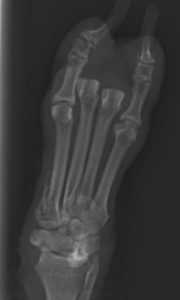
Two weeks post surgery, the specialist advised that the findings of the pathology report revealed that they got clear margins of the tumour when they amputated his toes, but there was destruction to the bone in those toes, which proved the aggressive nature of eccrine carcinoma.
The diagnosis meant that there could be microscopic spread, however, at that stage, there was no way of telling whether that was the case. Amputation of the leg was, therefore, not necessary as it was unclear whether it had spread to the bones in the rest of his leg.
As a precaution, the specialist suggested four treatments of chemotherapy over an eight-week period. He advised that some dogs cope well on chemotherapy, others not, and one to two percent could die therefrom. He said an alternative would be to send McCarthy for another CT scan in a few months to determine whether the cancer had spread and if so, to start chemotherapy then.
Unfortunately, due to this form of cancer being so rare, the specialist had no comparisons to previous cases and treatments to investigate further.
However, while deciding whether to go the chemotherapy route, McCarthy became severely ill again. Further blood tests revealed escalated liver enzymes. That poor little dog was then prescribed a cocktail of medication to aid the healing, and after weeks of repeated bouts of vomiting and lethargy, the specialist did an ultrasound which revealed pancreatitis as the cause of the elevated liver enzymes and McCarthy’s extreme discomfort. The decision as to whether or not to proceed with chemotherapy was made for me, as a pancreatic dog was not a good candidate for chemotherapy.
From One Level of Severity to the Next
Pancreatitis then took centre stage. McCarthy’s foot was fully healed and he had no trouble adjusting to his new gait, and we all forgot about the cancer while figuring out why he was having repeated bouts of pancreatitis.
The symptoms and treatment of the acute bout of pancreatitis, which was becoming chronic, will be discussed in detail in another post. I would like to walk other pet parents through our experience in dealing with that awful disease in the hope that those in similar situations with their beloved pets may gain insight therefrom and seek treatment as soon as possible. It is not a disease to be messed with!
Parting tip regarding Eccrine Carcinoma: If your pet presents with a mysterious cut on his/her paws, have it seen to by your vet if it is not healing within one week. It is always best to err on the side of caution as fast action can save your dog’s life.
Hi Delilah, Thank you very much for a very informative article. What makes this article extra special is the fact that you experienced this firsthand and therefore managed to add a touch of emotion. It really helps those who are in the process of dealing with a similar situation. Thank you!
Thank you, Wikus. If any of my content helps any other pet lover dealing with a similar experience, the purpose of having my website has been fulfilled. I appreciate your thoughts.
Thanks for your article. I thought of going through to see if I could get information useful in the care of my dog (a female pit bull that I’ve gotten very attached to). She’s been involved in a couple of fights, and I’m always weary of infection.
Reading through your article though, made me sad when I realised the seriousness of your McCarthy. I hoped to use the information you provide, although in a different way than I’d expected. Hopefully others will benefit from the sad experience you went through.Thanks again for the article.
Thanks for responding to my article Hugo. I am sorry to hear about your pit bull. What is the reason for her getting into fights? You may like to read my other article under Tips/Puppy Socialisation for some insights into socialising your dog.
I hope you find some valuable tips while researching to prevent her from getting into fights, but if she does, to get her to a vet for proper treatment of her wounds to prevent any serious damage or infections.